
Payment Links in Pakistan: How Businesses Collect Without a Checkout Page
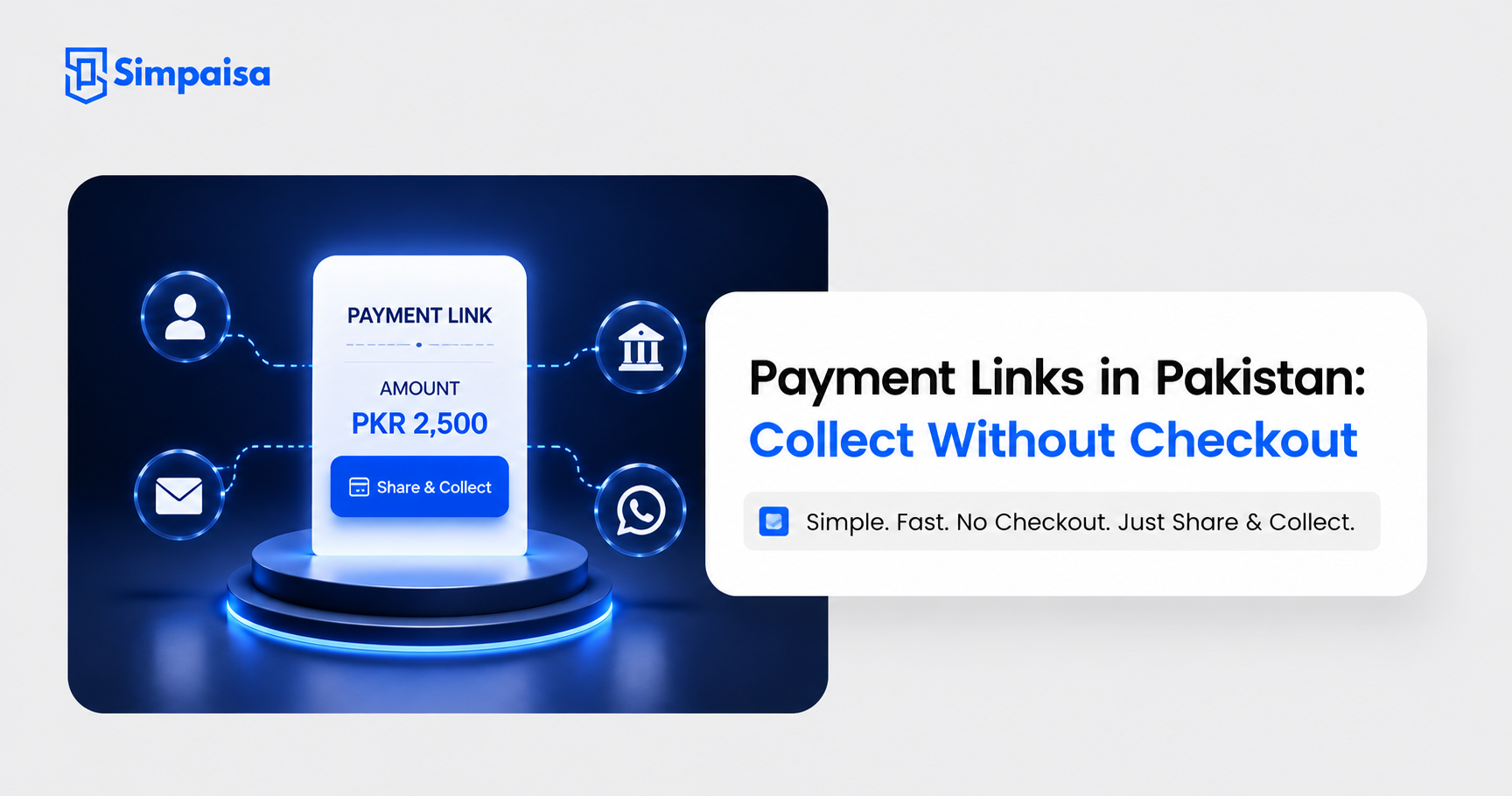
Payment links let businesses in Pakistan collect money from a customer without sending them to a checkout page. You generate a link, share it over WhatsApp, email, or SMS, and the customer pays using a wallet, card, or bank transfer. For finance teams chasing receivables across scattered channels, it removes the most common excuse for a late payment: the customer had no easy way to pay you.
TL;DR: What You'll Learn
- A payment link is a hosted payment page generated on demand. It is not a gateway replacement, and it is not a wallet.
- Pakistan had 195,849 point-of-sale terminals across 159,284 merchant locations in FY25, which means most business collection still happens outside any formal acceptance point.
- Account- and wallet-based methods accounted for 93% of e-commerce transactions in FY25, so a link that only supports cards will fail most of the time.
- The real operational cost of link-based collection is reconciliation, not integration.
- Links are a starting point, not an end state. Volume, recurring billing, and embedded checkout are the signals to move to an API.
- The same collection logic extends across all six of our markets, but the underlying channels differ in each one.
Why Businesses in Pakistan Lose Revenue at the Collection Step
Payment acceptance in Pakistan is concentrated where customers physically stand or where a website has a checkout page. According to the State Bank of Pakistan's Annual Payment Systems Review for FY25, the country had 195,849 point-of-sale terminals deployed across 159,284 merchant locations. Against the total number of registered businesses in the country, that is a narrow acceptance footprint.
Most business-to-business collection happens in neither place. It happens after an invoice is issued, after a service is delivered, after a sales conversation ends. The customer intends to pay. The seller has no mechanism to capture that intent at the moment it exists. So the payment moves to a bank transfer the buyer will make later, or a cheque, or a follow-up call three weeks on.
That gap between intent and capability is where working capital goes to die.
What a Payment Link Actually Is, and What It Is Not
A payment link is a secure, hosted payment page generated on demand and shared as a URL. The customer opens it, chooses a payment method, and completes the transaction. No website is required. No integration work is required to send the first one.
What it is not matters just as much. A payment link is not a substitute for a payment gateway. It sits on top of the same acquiring infrastructure and settles through the same rails. It is not a wallet, and it does not hold funds. It is a distribution method for a checkout, not a different kind of payment.
The reason it works in this market is behavioural. SBP's FY25 review records 6.2 billion transactions through mobile banking applications, a growth of 52% year on year. Customers are already comfortable completing payments on a phone. A link meets them where that habit already lives.
Where Payment Links Fit in a Collection Flow for Businesses in Pakistan
Payment links earn their place in specific, repeatable situations rather than as a general checkout strategy:
- Invoice collection. Attach a link to the invoice so settlement takes one tap instead of a manual transfer and a screenshot.
- Field and telesales. Close the payment during the conversation rather than after it.
- Subscription and renewal recovery. When a stored payment method fails, a link is the fastest path back to a completed charge.
- Advance payments and deposits. Secure commitment before work begins.
- Marketplace and vendor collections. Collect onboarding fees or commissions from merchants who are not yet integrated.
Digital adoption supports all five. Internet banking portals processed 297 million transactions in FY25, up 33% year on year, according to SBP. The buyer side of the market is ready. The seller side is usually the constraint.
Payment Links vs Full API Integration vs Hosted Checkout
The three approaches solve different problems, and most businesses eventually run more than one at the same time.
Note the last row. Links are the cheapest to start and the most expensive to operate at scale. That trade is acceptable for a hundred payments a month and painful at ten thousand.
Which Payment Channels a Link Should Support in Pakistan
This is where most link products quietly fail. SBP's FY25 review found that account- and wallet-based methods represented 93% of e-commerce transactions. A link that opens to a card form only will lose the overwhelming majority of Pakistani payers before they start.
The channel mix a link needs to cover:
- Mobile wallets: JazzCash, Easypaisa, HBL Konnect, and Alfa. SBP recorded 79.2 million branchless banking mobile application users in FY25.
- Bank applications and transfers: IBFT (Inter Bank Funds Transfer) and direct bank transfers, serving 24.1 million mobile phone banking users.
- Cards: Visa, Mastercard, and UnionPay, across a base of 59.3 million cards in issue.
Raast, the country's instant payment system operated by SBP, has expanded the underlying rails available to the market and more than doubled in both transaction count and value in FY25. That growth reshapes customer expectations around settlement speed even where it is not the method being used directly.
Our payment collection infrastructure brings these channels together behind a single integration, so a link generated once presents every relevant method to the payer rather than forcing a channel choice on them.
Reconciliation: The Part Most Businesses Underestimate
Sending links is easy. Knowing which payment belongs to which invoice is not. This is the operational cost nobody prices in.
Pakistan processed 9.1 billion retail transactions worth PKR 612 trillion in FY25 per SBP, a 38% rise in volume year on year. Volume growth at that pace turns manual matching into a structural problem rather than an administrative one. A finance team that spends its month reconciling a spreadsheet of screenshots against a bank statement has not solved collection. It has moved the cost.
What actually fixes it:
- A unique reference tied to each link at the point of generation, carried through to settlement.
- Webhook notifications on payment status rather than manual dashboard checks.
- One settlement report covering every channel, not one per wallet and one per bank.
- Link expiry and single-use controls so a link cannot be paid twice or paid late.
Pro tip: decide your reference convention before you send your first link. Retrofitting a reference scheme onto six months of completed payments is significantly harder than defining it on day one.
Compliance and Security Requirements for Link-Based Collection
A payment link is a public URL that accepts money. That makes it a security surface, and it makes the party generating it accountable.
The requirements that apply:
- Card data handling. Any link accepting card payments must process that data in a compliant environment. Our platform is PCI DSS and ISO 27001 certified, covering the Payment Card Industry Data Security Standard and the international information security management standard.
- Regulatory framework. Collection in Pakistan operates within the State Bank of Pakistan's framework, either through direct licensing or through regulated partnerships. Simpaisa operates via regulated partnerships and has applied to SBP for a Payment Service Operator (PSO) licence.
- AML obligations. Anti-Money Laundering (AML) requirements apply to link-based collection as they do to any other acceptance method, including Suspicious Transaction Report (STR) filing where thresholds and indicators are met.
- Link hygiene. Expiry windows, amount locking, and single-use enforcement prevent a shared URL from becoming an open payment endpoint.
E-money wallet transactions doubled in both volume and value in FY25 according to SBP. Rapid channel growth tends to attract equally rapid fraud attention, which makes these controls a present concern rather than a future one.
When to Move From Links to a Single API Integration
Links are a starting position. Four signals indicate it is time to integrate properly:
- Volume. When link generation becomes a daily manual task, the labour cost has overtaken the integration cost.
- Recurring revenue. Subscriptions need tokenization and stored payment methods. Links cannot carry a billing relationship forward.
- Product experience. When customers expect to pay inside your application, redirecting them out of it costs conversion.
- Payouts. If you also disburse to vendors, drivers, creators, or freelancers, both directions should run through one integration rather than two systems.
That last point is underrated. Simpaisa payout and disbursement infrastructure runs on the same integration as collection, covering JazzCash, Easypaisa, HBL Konnect, Alfa, and bank accounts. Businesses that build collection and disbursement separately usually rebuild one of them within a year.
Extending Payment Links Across Frontier Markets
The collection problem repeats across every frontier market, but the channels do not transfer. A link built for Pakistani wallets means nothing to a customer in Dhaka.
Bangladesh Bank data shows over 1.5 million registered merchant accounts on mobile financial services platforms as of December 2024, an acceptance base built on entirely different providers than Pakistan's. Nepal, Egypt, Iraq, and Saudi Arabia each carry their own dominant methods, settlement conventions, and regulatory expectations.
We operate across all six of these markets. The value of a unified layer is that expansion becomes a configuration decision rather than a new integration project, and that a business entering a second market does not restart its collection stack from zero.
Expert Insight: Why Most Businesses Get This Wrong.
Most teams evaluate payment links on how quickly they can send the first one. That is the least important variable. The first link takes minutes regardless of provider. The question that determines whether links help or hurt is what happens on payment number four hundred, when your finance lead is matching wallet references against bank statements by hand. We have watched businesses adopt links to accelerate collection and then lose the gain to reconciliation labour within two quarters. Choose on settlement reporting and reference handling, not on time to first payment.
Conclusion
Payment links for businesses in Pakistan solve a narrow problem exceptionally well: capturing payment at the moment a customer is willing to pay, without a checkout page standing in the way. Three things determine whether they work. The link must present wallets, bank transfers, and cards together, because account and wallet methods carry the overwhelming majority of digital payments here. Reconciliation must be designed before volume arrives, not after. And links should be understood as a first step toward a single integration covering both collection and payouts, rather than a permanent arrangement.
If you are weighing link-based collection against a full integration, or running both, our team can map the right sequence against your volume and market plans. Talk to a payment specialist.