
Payment Gateway Integration in Pakistan: A Developer's Architecture Guide
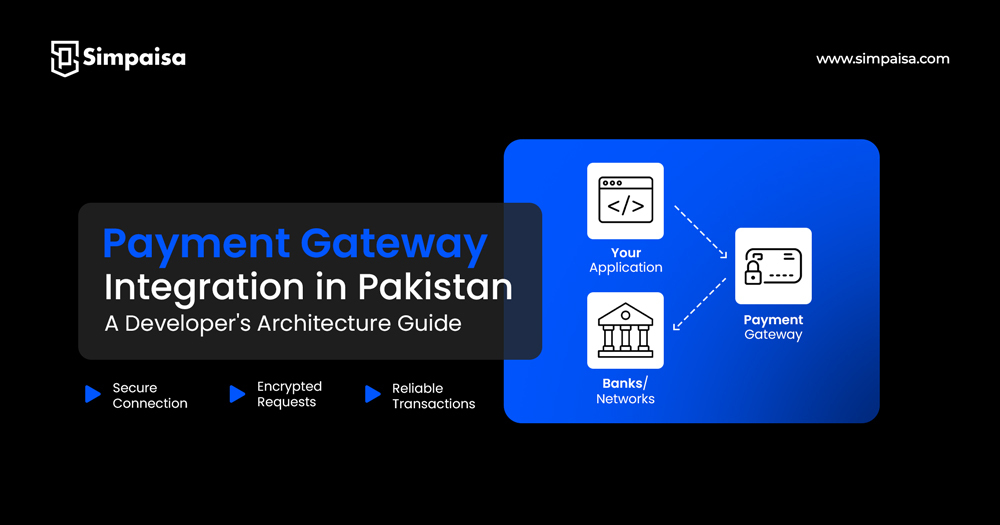
Payment gateway integration in Pakistan fails for a predictable reason: engineering teams model the card flow first and treat wallets as an edge case. The market runs the other way. Account and wallet channels carry 93% of online transactions. Build card-first, and you have optimised the minority path, then bolted the majority onto it.
TL;DR What You'll Learn
- Account- and wallet-based channels account for 93% of e-commerce transactions in Pakistan. Cards account for roughly 8% by volume, though 32% by value, which means cards matter for basket size and wallets matter for conversion.
- Wallet, card, and bank transfer are not three configurations of one flow. They are three different state machines with three different terminal conditions.
- The single most expensive architectural decision is redirect versus in-app authorisation, and it is made in week one.
- Payment state in Pakistan is asynchronous by default. If your system trusts the client for confirmation, you will double-charge customers.
- Your Payment Card Industry Data Security Standard (PCI DSS) scope is decided by your architecture, not your paperwork.
- Reconciliation is the system your finance team needs and your engineering team forgets to build.
What a Payment System in Pakistan Actually Has to Handle
Pakistan processed 9.1 billion retail transactions worth PKR 612 trillion in the last reported fiscal year, up 38% in volume. Digital channels carried 88% of that, rising from 78% two years earlier. This is not an emerging digital market. It is a digital market with a distribution that surprises people who have integrated payments elsewhere.
Here is the shape that matters to your architecture. Branchless banking mobile applications reach roughly 79.2 million users. Conventional bank applications reach 24.1 million. Payment cards number 59.3 million, but card issuance is not card usage: the entire point-of-sale network across the country enables about one million card payments per day across 195,849 terminals. Meanwhile, over 100 million adults sit outside the formal banking system entirely.
Read those numbers as an engineer rather than a marketer. Your addressable users overwhelmingly hold a wallet, not a card. The wallet is your primary path. The card is your high-value path. If your checkout treats the card form as the default and the wallet as an alternative tucked behind a link, your funnel is fighting the market.
For market context, the State Bank of Pakistan's instant payment rail, Raast, has grown from 147.2 million transactions to 1,276.0 million transactions across three fiscal years, an eight-fold increase, and its Person-to-Merchant service is expanding acceptance further. The direction of travel is account-to-account. Any system you design should assume that direction continues.
Build Direct or Integrate Once: What You Actually Own
The build-versus-integrate question is usually framed in terms of cost. That framing is wrong. Frame it as ownership, because ownership is what you are actually choosing.
Integrate directly with each provider and you own, per provider: a commercial contract, a separate sandbox, a distinct authentication scheme, a distinct callback contract, a distinct settlement file format, a distinct set of error semantics, a distinct state machine, and a distinct on-call surface at 3 am. Multiply by JazzCash, Easypaisa, HBL Konnect, Alfa, your card acquirer, and your bank transfer rail. Then multiply again for every market you enter.
The first integration is not the expensive one. The twentieth change is. Providers version their APIs independently, adjust their callback payloads, and revise settlement formats on their own schedules, none of which align with your release calendar. Every one of those changes lands on your team as unplanned work, and none of it ships product.
The alternative is to own one contract, one authentication scheme, one callback contract, one state machine, and one reconciliation model, and to let someone else absorb provider churn. That is the trade: you give up direct control of the provider relationship, and you get back your engineering roadmap. For most platforms, payments are infrastructure, not differentiation. The honest question is whether your team wants to be in the payment maintenance business.
The Redirect Decision: Where Most App Payment Flows Lose Money
Every payment integration in Pakistan forces one early choice: does the user stay inside your application, or do you hand them off to a hosted page?
Redirect flows are faster to ship, and they cost you on every transaction afterwards. In a mobile application, a redirect means a WebView or an external browser handoff. You lose control of the visual context, so the user sees an unfamiliar page at the exact moment they are deciding to part with money. You lose session continuity, so app state must be rebuilt on return. You depend on a return path that breaks when the user backgrounds the app, when the operating system reclaims memory, or when the network drops mid-handoff. And you inherit an ambiguity that never resolves cleanly: the user vanished, and you do not know whether they paid.
That last point is the one that matters. A redirect does not just cost conversion; it costs certainty. The user who closes the webview after authorising but before the return callback has paid, and your system does not know it.
A clean application programming interface (API) integration keeps authorisation inside your interface. You control the moment of decision, you keep session state, and your payment state comes from a server-side signal rather than a browser round trip. This is the single architectural choice with the most direct revenue consequence, and it is almost always made in week one by whoever is prototyping.
Three Payment Methods, Three Different State Machines
This is the section most integration guides skip, and it is where teams lose months.
Wallet, card, and bank transfer are not variations of one flow with different parameters. They differ in who initiates confirmation, how long the confirmation window stays open, and what a terminal state even means.
The wallet column is the one that breaks foreign assumptions. There is no synchronous "approval" to return to your caller. You initiate, the user leaves your application, they approve in their wallet app, and your system learns about it later through a server-side notification. Your data model must represent pending as a legitimate long-lived state, not as a transient blip between request and response.
Cards behave the way most engineers expect, which is exactly why teams model cards first and then discover that their entire state machine assumes synchronous confirmation. Retrofitting asynchronous wallet flows onto a synchronous card-shaped model is a rewrite, not a refactor. Model the wallet flow first, and the card becomes the easy case.
Payment Gateway Integration in Pakistan Is Asynchronous by Default
Once you accept that wallet flows dominate and wallet flows are asynchronous, several design rules follow, and they are not optional.
Never trust the client for the payment status. The mobile application knows the user tapped Approve. It does not know that the transaction has settled. Payment state is authoritative only from a server-side signal, verified against the sending party. Treat any client-reported success as a hint to refresh, never as a fact to record.
Webhooks are your source of truth, so build for their reality. Webhooks arrive late. They arrive twice. They arrive out of order. They arrive while your service is deploying. Occasionally, they do not arrive at all. Your receiver must acknowledge fast and process separately, because a slow handler triggers a retry, and a retry you were not expecting becomes a duplicate you did not handle.
Idempotency is the whole game. Every payment-mutating operation needs an idempotency key, and every webhook handler needs to be safe to run repeatedly. The same notification delivered five times must produce one ledger entry. Teams that skip this ship correctly for a month and then double-credit an account during their first provider retry storm.
Reconciliation is not optional; it is the backstop. Webhooks fail. When they do, the only thing standing between you and a silently wrong ledger is a scheduled job that compares your records against the provider's. Every serious payment system in this market has one.
The State Bank of Pakistan's Annual Payment Systems Review reports e-money wallet applications doubling in both transaction volume and value in a single year, the fastest growth of any channel. The asynchronous path is not a legacy quirk you can wait out. It is the growth path.
The Failure Modes That Cost You Real Money
Payment engineering is failure engineering. The happy path is a fraction of the code that matters.
Timeout ambiguity. Your request times out. Did the transaction fail, or did it succeed and the response die in transit? These require opposite responses, and you cannot tell them apart from your side. Resolve by querying transaction status by your own reference, never by assuming and never by blindly retrying.
The double charge. A user taps pay; nothing visible happens, and they tap again. Without idempotency keys, that is two authorisations. In a wallet flow where confirmation is delayed by design, this is not an edge case.
The orphaned authorisation. Card authorised, capture never fired because your service crashed in between. The customer sees a hold on funds they did not spend. You see nothing wrong. They find out before you do, and they tell support.
The expired OTP window. The user got the prompt, went to answer a phone call, and came back after the window closed. No failure signal fires. The transaction simply stops existing from the provider's perspective, while yours still shows pending. Your timeout policy has to be shorter than your patience and longer than a phone call.
Silent partial settlement. The transaction succeeded, but the settlement file disagrees on the amount. Only reconciliation catches this, and only if you built it.
There is a security dimension too. A Wakefield Research and Visa survey reported that 55% of Pakistanis had experienced online financial fraud, and the central bank has explicitly flagged rising cybercrime as a threat to the financial system. Fraud controls are not a phase-two concern in this market.
Reconciliation and Settlement: The System Behind the System
Reconciliation is the part of payments that engineering scopes at two days and finance discovers at quarter close.
Your system holds one view of what happened. The provider holds another. Your bank holds a third. These disagree routinely and for mundane reasons: a webhook that never landed, a refund processed out of band, a transaction that settled in a different window, a fee deducted before settlement.
Build for it deliberately. Keep an immutable ledger where records are appended, never mutated, so state transitions are auditable rather than inferred. Carry your own transaction reference end to end and make sure it survives into the settlement file, because matching on amount and timestamp fails the moment two customers pay the same amount in the same minute. Run automated matching on a schedule, and route exceptions to a human queue rather than a log nobody reads.
Understand also that authorisation timing and settlement timing are different clocks. A transaction can be authorised instantly and settled on a cycle. Your finance team plans cash against settlement, not authorisation, and the gap between the two is a question you should answer before you sign, not after.
Compliance Scope Is an Architecture Decision, Not a Paperwork One
PCI DSS scope is not determined by what you write in a policy document. It is determined by where the card data flows.
If cardholder data touches your servers at any point, your environment is in scope, and you own the full weight of the standard. If card data is captured and tokenised entirely within a certified environment and never reaches your infrastructure, your scope reduces to the integration layer. That is a decision your architecture makes on day one, and reversing it later is expensive.
We have covered the requirements, the enforcement posture, and what to verify in a provider in our guide to PCI DSS compliance for businesses in Pakistan. For this guide, one line matters: decide where card data lives before you write the checkout, not after.
If Your App Also Pays People Out
Many platforms discover late that they need money to flow both ways. Marketplaces pay sellers. Ride-hailing platforms pay drivers. Freelance and content platforms pay creators.
Payouts are a separate system with separate failure modes, and they are not the reverse of the acquiring flow. Beneficiary details need validating before you send, not after a failure. Batch operations need partial-failure semantics because a file of 5,000 payouts where 12 fail is the normal case, not the exception. And a failed payout is materially worse than a failed collection: a customer who cannot pay you tries again, while a driver who was not paid calls support and tells everyone. If two-way flow is on your roadmap, evaluate payout and disbursement infrastructure alongside acquiring, rather than a year later.
Production Readiness: What to Verify Before You Go Live
Work through this before launch, not after your first incident.
- Every payment-mutating endpoint accepts and honours an idempotency key.
- Webhook handlers are idempotent and verified for authenticity before processing.
- Webhook receipt is acknowledged immediately and processed asynchronously.
- Pending is a first-class, long-lived state in your data model, not a transient one.
- Transaction status can be queried by your own reference, independently of webhooks.
- Timeout policy is explicit per method because wallet and card windows differ.
- Automated reconciliation runs on a schedule, with exceptions routed to a human.
- Your ledger is append-only, and every state transition is auditable.
- Card data flow is documented, and your PCI DSS scope is a known quantity, not an assumption.
- Refund and partial-refund paths are built and tested, not deferred.
- Alerting fires on success-rate drops per method, not just on service errors.
- Someone owns payments on-call and knows the difference between a provider outage and a bug.
If items 1, 2, or 7 are unchecked, you are not production-ready, regardless of how well the happy path demos.
How We Approach Payment Gateway Integration in Pakistan
We built Simpaisa around the argument this guide makes: the complexity is real, most of it is not your differentiation, and it should sit on our side of the boundary.
One integration reaches JazzCash, Easypaisa, HBL Konnect, Alfa, Visa, Mastercard, UnionPay, Inter-Bank Funds Transfer (IBFT), and bank transfers. You implement one authentication scheme, one payment request contract, one callback contract, and one state machine. When a wallet provider revises its integration, that lands on us. Your team does not replan a sprint.
Our integration is a clean API with no redirects. Authorisation stays inside your application, which keeps you in control of the moment of decision and keeps your payment state server-side.
Card data is captured and tokenised inside our environment and does not touch your infrastructure, which is what reduces your compliance scope rather than merely documenting it. We are PCI DSS and ISO 27001 certified.
The same integration extends to Bangladesh, Nepal, Egypt, Iraq, and Saudi Arabia. Entering a second market is a configuration decision, not a second integration project. You can review Simpaisa's single API for payment acquiring.
Expert Insight: Why Most Businesses Get This Wrong.
The mistake is not choosing the wrong provider. It is modelling Pakistan as a card market with wallet support, when it is a wallet market with card support. That single inversion produces a synchronous state machine, a card-first checkout, a pending state treated as a bug, and a reconciliation job scoped as a nice-to-have. None of those are provider problems, and switching provider fixes none of them. Teams that model the asynchronous wallet flow first find that cards slot into it easily. Teams that do the reverse rewrite their payment layer within a year, usually right after their first double-charge incident.
Conclusion
Three things decide whether payment gateway integration in Pakistan goes well. First, model the wallet flow before the card flow, because account and wallet channels carry the overwhelming majority of online transactions and their asynchronous shape drives your entire state machine. Second, treat idempotency and reconciliation as launch requirements rather than hardening tasks, because the failure modes they prevent are the ones that cost real money and real trust. Third, decide deliberately where card data lives, because that choice sets your compliance scope permanently.
The complexity here is genuine. Very little of it is your product. If you would rather spend your engineering time on what your users actually came for, talk to our payments team about how your integration would actually work.
Frequently Asked Questions
- Why can't I just use my existing global payment gateway in Pakistan?
Global gateways generally handle cards, and cards are a minority of Pakistani online transactions by volume. Without local wallet rails such as JazzCash, Easypaisa, HBL Konnect, and Alfa, you are addressing a fraction of your potential users. The gap is distribution, not technology. - What is the difference between authorisation and settlement in a wallet payment?
Authorisation is the user approving the transaction in their wallet application, which happens asynchronously and reaches you through a server-side notification. Settlement is when funds actually move to your account, on a separate cycle. Your system tracks both, and your finance team plans cash against settlement. - Do I need to handle wallet, card, and bank transfer separately in my code?
You need to model them as distinct state machines, because their confirmation timing and terminal states genuinely differ. What you do not need is a separate integration per provider. A unified integration lets you handle the behavioural differences in your own logic while implementing one contract. - How do I stop double charges when a wallet confirmation is delayed?
Idempotency keys on every payment-mutating request, idempotent webhook handlers, and payment state derived only from server-side signals rather than client reports. If a user taps pay twice and your system creates two authorisations, the problem is in your request layer, not the provider's.