
How Pakistani Marketplace Platforms Split Payments and Pay Their Vendors
How Pakistani Marketplace Platforms Split Payments and Pay Their Vendors
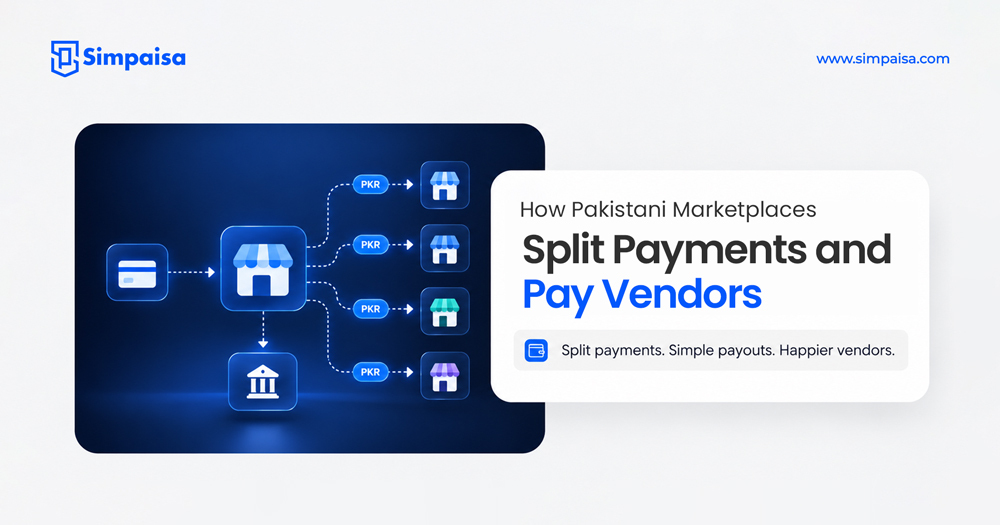
A marketplace does not pay vendors the way a shop pays a supplier. Every buyer order has to be split across multiple sellers, net of commission, tax, refunds, and holds, then routed to each vendor's chosen channel. Getting marketplace split payment right in Pakistan is a ledger and money-flow problem first, and a payout problem second. Here is how the money actually moves, and where platforms get it wrong.
TL;DR: What You'll Learn
- Paying vendors is really a split-and-settle problem: one buyer payment fans out across many sellers after commission, tax, and refunds come out.
- Cash on delivery still drives roughly three-quarters of Pakistani e-commerce orders, so most vendor payouts are split against money that has not fully cleared yet.
- Return-to-origin rates commonly run between 18% and 35%, which is why payout timing has to follow order events, not a fixed calendar.
- Who holds the money between sale and payout, your platform or a payment facilitator, decides your compliance load more than any other design choice.
- Building a split-and-payout engine in-house means owning a ledger, channel routing, reconciliation, retries, and multi-rail compliance before you ship a single marketplace feature.
- A single API can cover both buyer-side collection and vendor-side disbursement, so your team integrates once for the full money flow.
What "Paying Your Vendors" Really Means for a Marketplace
A marketplace is a two-sided money machine: buyers pay the platform, and the platform owes dozens or hundreds of sellers. According to ECDB, Pakistan's e-commerce market generated around US 5.8billion in the most recent full year,and PCMI puts it near US 7.7 billion, with a 17% growth rate projected through the medium term. Behind those numbers sit thousands of sellers. Daraz alone works with roughly 34,500 sellers, and the wider market, including social commerce, moves an estimated 150 to 250 million orders a year.
The payout side is not one transfer. It is thousands of net calculations, each one a gross sale minus commission, minus tax, minus refunds, minus holds, routed to the seller's preferred rail. This is why marketplace payouts break in a way that ordinary vendor payments do not. The design work is in the split and the ledger, not the transfer itself. Where it helps, this guide shows how Simpaisa single-API approach removes the multi-rail problem most platforms hit by their second year.
Split Payments: How One Buyer Order Becomes Many Vendor Payouts
The core mechanic is fan-out. A single checkout can contain items from three different sellers, which means one buyer payment must divide cleanly into three vendor ledgers. The State Bank of Pakistan's FY25 Annual Payment Systems Review recorded 9.1 billion retail transactions worth PKR 612 trillion, with digital channels handling 88% of them, so the collection side is mature. The complexity lives in what happens after collection.
A correct split for a single line item looks like this:
Do this once, and it is arithmetic. Do it across hundreds of sellers, every settlement cycle, with cash-on-delivery money that clears on a delay, and it becomes the single most error-prone part of running a marketplace. The split logic has to be deterministic, auditable, and reversible, because every one of those deductions is a number a vendor can dispute.
Custody Models: Who Holds the Money Between Sale and Payout
Before you build anything, answer one question: whose account does the money sit in between the sale and the payout? There are two broad models.
- In a merchant-of-record model, the platform collects buyer funds into its own account, then disburses to sellers. The platform controls timing and reserves, but it also carries the full weight of holding other people's money.
- In a facilitated model, a payment facilitator collects and settles into per-vendor structures, and the platform orchestrates the split without warehousing the funds itself.
This choice drives your regulatory exposure more than any feature decision. Holding pooled vendor balances means auditable segregation, reserve discipline, and reporting that the State Bank of Pakistan expects at scale. Simpaisa, a payment facilitator, collects and settles through regulated partnerships and follows SBP guidelines, which lets platforms run a clean split-and-settle flow without building the fund-custody machinery from zero.
The model you pick should match your volume and your appetite for compliance overhead, not whichever integration was fastest to wire up.
Commission, Tax, and Refunds: Getting the Per-Vendor Math Right
Every payout carries math that a vendor will check. That math has three moving parts, and each one has a way of going wrong at scale. Commission is the platform's cut, and it has to be transparent per transaction, because sellers who cannot see how their commission was calculated churn quickly. Tax is the part most platforms underestimate: Pakistani marketplaces are increasingly expected to withhold tax at source on vendor payments and to produce settlement statements that hold up to FBR scrutiny. Refunds are the quietest killer, because a return that lands after payout becomes a clawback.
That last point is not theoretical. DHL reports a national return-to-origin rate between 18% and 20%, and other operators put the range as high as 30% to 45% for weaker stores. When one in five parcels can bounce back, paying a vendor the full amount before the return window closes means chasing money you already sent. The fix is a per-vendor sub-ledger that tracks earned, held, deducted, and payable balances separately, so a refund reverses the right slice without unwinding the entire payout. Marketplaces that want to see the disbursement channel and settlement side in depth can read our companion guide on how to automate the payout channels and settlement side.
Connecting Payout Release to Order Events, Not the Calendar
Fixed payout dates fight the way marketplace orders actually behave. Orders close at different times, return windows expire at different times, and refunds happen on no schedule at all. A calendar-based payout run either pays too early, before a return window shuts, or too late, which pushes seller cash flow into pain. The better model is event-driven: order placed, then delivered, then return window closed, then payout released, each stage firing the next.
The Pakistani logistics market is already moving this way. Industry reporting shows couriers now releasing up to 50% of cash-on-delivery value at pickup, cutting seller payout waits from 7 to 15 days down to 24 to 48 hours. That only works when release is tied to a verifiable event rather than a weekly batch. An API that emits a webhook on each order state change lets your platform release the right vendor's money at the right moment automatically, instead of holding everyone to the slowest common cycle.
Multi-Vendor Carts and Partial Fulfilment: The Hard Edge Cases
The clean split falls apart at the edges, and marketplaces live at the edges. A single cart with three sellers can produce a partial shipment when one seller is out of stock, a partial refund when one item is returned, and a full cancellation from a fourth. Each of these has to resolve inside the same order without corrupting the other vendors' balances. Multiply that by Daraz-scale volume, where a single platform can process 50 to 80 million orders a year, and edge cases stop being rare events and become daily operations.
Handling this needs a split engine that treats each line item as its own settlement object, not the order as one lump. Partial fulfilment releases only the shipped seller's share. A partial refund reverses only that line. A cancelled item never enters the payable ledger in the first place. Platforms that model the split at the line-item level absorb these cases quietly. Platforms that model it at the order level end up doing manual corrections every single day.
Build Your Own Split-and-Payout Engine, or Use an API
This is the decision that actually matters, and it is a build-versus-buy call. Building in-house means owning a vendor master with KYC, a per-vendor ledger, channel routing logic, a disbursement engine, retry and exception handling, reconciliation, and the compliance posture to hold or move funds. Each payout rail you add, bank accounts plus JazzCash, Easypaisa, HBL Konnect, and Alfa, is a separate integration that breaks on its own schedule and needs its own maintenance. That is engineering time spent on payment plumbing instead of marketplace features.
The alternative is to treat the split as your logic and the payout as someone else's rails. Simpaisa disbursement API handles bank, JazzCash, Easypaisa, HBL Konnect, and Alfa payouts through one integration, and the same integration covers buyer-side collection, so you wire up the full marketplace money flow once. Teams weighing the technical lift should look at our payment gateway integration architecture for developers, and platforms already at high volume can see how to pay thousands of vendors or freelancers at once.
Compliance for Splitting and Holding Vendor Funds
Any split-payment flow that touches vendor money has to clear three compliance layers, and they get stricter as you grow.
- First, vendor onboarding needs real KYC: CNIC or NTN capture, account-ownership verification, and screening against sanctioned-party lists before a single rupee moves.
- Second, suspicious activity has to be reportable. Because marketplace flows are cash-free, currency transaction reporting does not apply, but suspicious transaction reporting obligations still do.
- Third, the data and money-handling layer needs certification that enterprise partners now treat as table stakes.
With digital channels already carrying 88% of retail payments per SBP, regulators expect an audit trail that manual and pooled flows cannot produce. Simpaisa is PCI DSS and ISO 27001 certified, operating under regulated partnerships and following SBP guidelines, which gives marketplaces a trust layer that is expensive to build internally. For the full picture on onboarding checks and screening obligations, our practical guide to KYC and AML compliance for payments in Pakistan breaks down what a compliant flow needs.
Expert Insight: Why Most Businesses Get This Wrong
Most marketplaces shop for a "payout tool" and treat vendor payments as a last-mile transfer problem. That is backwards. The payout is the easy part. The hard part is the split and the ledger that sit upstream of it, the logic that decides exactly what each vendor is owed after commission, tax, refunds, and holds. Bolt a fast payout API onto a spreadsheet ledger, and you have automated the wrong 10% of the problem. The platforms that scale cleanly build the split logic first, then let the rails handle the transfer.
Conclusion
Three things decide whether your vendor payouts scale. First, treat this as a split-and-settle problem: the money-flow logic upstream matters more than the transfer at the end. Second, tie payout release to order events like delivery and return-window closure, because with return rates running as high as a third of orders, calendar-based payouts either pay too early or too late. Third, decide the build-versus-buy question early, because every payout rail you maintain in-house is engineering time not spent on your marketplace. Simpaisa built our infrastructure around exactly this profile: one API for the split, the collection, and the disbursement, PCI DSS and ISO 27001 certified, and operating under regulated partnerships. Ready to map your marketplace's money flow? Talk to our team, and we will walk through your split and settlement design.
Frequently Asked Questions
What is a split payment in a marketplace context?
It is dividing a single buyer payment across multiple vendors after commission, tax, and refunds are deducted. Each seller receives only their net share, routed to their preferred channel.
Can a marketplace in Pakistan hold vendor funds before payout?
Yes, but holding funds carries real compliance responsibility, which is why many platforms settle through a payment facilitator operating under regulated partnerships. The right model depends on your volume and risk profile.
How quickly should marketplace vendors be paid?
Release should follow order events such as delivery and return-window closure, not a fixed date. For most product categories, this lands between T+1 and the end of the return window.
Should we build a payout system or use an API?
Building means owning the ledger, routing, reconciliation, and compliance yourself. Most marketplaces move to an API once they pass a few hundred active vendors.